Why Your AI Romance Stories Feel Off
Let’s not sugarcoat it.
You’ve probably tried something like:
“Write a romance story about a billionaire and a woman who falls in love”
And what did you get? Something that technically works, but feels like it was written with no soul, no tension, and definitely no reason to keep reading.
Here’s the thing most people miss: AI isn’t bad at romance. You’re just giving it weak direction. Once that’s fix, that’s when the real stories are made. Addictive stories aren’t about “what happens”, they’re about how it unfolds moment by moment.
Why Most AI Romance Prompts Fail (Quick Reality Check)
If your stories feel mid, it’s usually one of these:
1. You’re Prompting Ideas and Not Emotional Experiences
“Write a romance about…”
That’s surface-level. You didn’t tell AI how to make the reader feel.
2. There’s No Escalation
Everything stays at the same emotional level.
No build. No tension spike. No turning point.
3. You’re Not Forcing Dialogue
AI will avoid dialogue unless you demand it, and dialogue is where the chemistry lives.
4. Nothing Is At Risk
If nobody can lose anything, Nobody cares what happens.
The Addictive Story Engine
Every binge-worthy romance hits these 4 elements:
Desire– What do they want—and why is it complicated?
Tension– What’s constantly pulling them apart?
Stakes– What could they lose?
Emotional Payoff– What moment makes the reader feel something?
Most prompts don’t include all four. That’s why the story often feels forgettable.
How to Use AI Romance Prompts (Without Getting Basic Results)
Before you jump into the prompts, do this first:
1. Be specific . Don’t say “rich man.” Instead say , “a high-profile CEO with a reputation to protect”
2. Stack your prompts
Prompt → Output → Refine → Continue
This is how you build layered stories fast.
3. Force emotional depth
Use phrases like:
“Include emotionally layered dialogue”
“Add internal conflict that contradicts their actions”
“Escalate tension before resolving the scene”
These small tweaks are the difference between, “meh” and “I need part 2 right now !”
10 AI Romance Scene Starter Prompts
1. The Breakup That Still Hurts
Prompt:
Write a scene where two people run into each other after a breakup that didn’t fully resolve. Their interaction is polite on the surface, but there are still feelings underneath.
Include:
- Brief dialogue
- Subtle emotional tension
- A moment where something almost gets said
Why It Works: Unfinished relationships naturally create tension. Readers lean in because they can feel what’s not being said.
2. The Attraction You Should Ignore
Prompt:
Write a scene where a woman meets someone she feels instantly attracted to—but knows she should stay away from.
Include:
- Her internal hesitation
- A small interaction between them
- A hint that this could lead to complications
Why It Works: Conflict between desire and logic pulls readers in immediately. It creates curiosity about what choice she’ll make.
3. The Man Who Notices First
Prompt:
Write a scene where a man notices a woman before she notices him, and something about her stands out to him.
Include:
- What draws his attention
- His initial thoughts
- A small moment where their paths cross
Why It Works: Shifting perspective adds intrigue and builds anticipation before the connection fully happens.
4. The Place She Doesn’t Belong
Prompt:
Write a scene where a woman finds herself in an environment that feels unfamiliar or out of her comfort zone, and someone takes interest in her.
Include:
- Description of the setting
- Her awareness of being out of place
- A subtle interaction with someone watching her
Why It Works: Contrast creates instant tension. Readers are curious how she’ll navigate a space where she doesn’t quite fit.
5. The Moment That Lingers
Prompt:
Write a scene where two people share a brief interaction that seems small—but sticks with one of them afterward.
Include:
- A short interaction
- A subtle emotional reaction
- A moment of reflection later
Why It Works: Small moments that carry emotional weight feel real and relatable, making readers want to see what happens next.
6. The Unexpected Reunion
Prompt:
Write a scene where two people unexpectedly see each other after a long time apart.
Include:
- Their immediate reaction
- Brief dialogue or awkward interaction
- A sense that there’s history between them
Why It Works: Surprise reunions instantly create emotional tension. The past is felt without needing a full explanation.
7. The Attention Shift
Prompt:
Write a scene where someone important or influential suddenly takes interest in a woman for an unexpected reason.
Include:
- What makes her stand out
- His reaction to noticing her
- A small moment of interaction or observation
Why It Works: Sudden attention creates intrigue and raises questions about what makes her different.
8. The Stuck Together Moment
Prompt:
Write a scene where two people are forced to spend time in close proximity, such as waiting, traveling, or stuck somewhere together.
Include:
- Their initial reaction to being near each other
- Small dialogue or silence
- A shift in how they perceive each other
Why It Works: Forced proximity naturally builds tension and creates opportunities for connection or conflict.
9. The Slip You Can’t Take Back
Prompt:
Write a scene where a woman accidentally reveals something personal in front of someone she didn’t intend to.
Include:
- What she reveals
- Her immediate reaction
- The other person’s response
Why It Works: Accidental vulnerability creates emotional depth and raises the stakes instantly.
10. The Silent Standoff
Prompt:
Write a scene where two people share a moment of intense eye contact or unspoken tension without saying much.
Include:
- Body language and physical cues
- Internal thoughts from at least one character
- A shift in the energy between them
Why It Works: Silence builds anticipation. What isn’t said often creates stronger tension than dialogue.
Why These Work
Let’s be honest. If you use these prompts, your writing will improve immediately. I remember how flat my stories were before I started using these prompts.
They give you better setups and better scenes, but they don’t fully control:
Scene pacing
Emotional timing
Dialogue progression
Tension layering
This is where addictive storytelling lives.
Want Prompts That Actually Do the Heavy Lifting For You?
That’s exactly why I created:
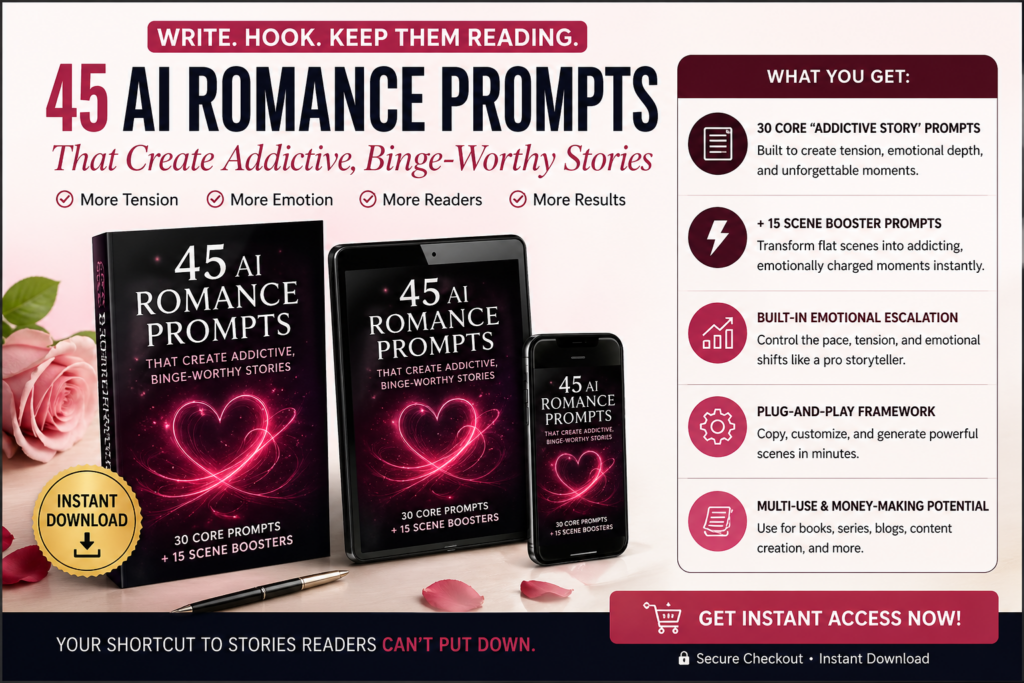
This isn’t just “more prompts.” It’s a structured system.
What Makes These Different:
- Emotional escalation built into the prompt
- Scene structure included (not just an idea)
- Dialogue guidance
- Designed for binge-worthy storytelling
Who This Is For:
- Writers who want faster, stronger results
- Beginners tired of guessing what works
- Anyone trying to turn stories into content or income
- Stories that don’t go anywhere
If you’re tired of:
Flat scenes
Weak emotional pull
Stories that don’t go anywhere
This is your shortcut to fixing it.
FAQ (What You Actually Need to Know)
Do I need writing experience to use these prompts?
No. These prompts guide the structure for you—you’re learning while creating.
Why does AI writing feel repetitive sometimes?
Because most prompts don’t include variation in emotional beats, dialogue, or pacing. You’re getting the same structure over and over.
How do I make AI-generated romance feel more real?
Force:
- Dialogue
- Internal thoughts
- Conflict between what characters say vs feel
That’s what creates realism.
Can I turn these stories into a book or series?
Yes—and that’s actually one of the best ways to use them. Serialized romance performs extremely well.
How do I make readers “addicted” to my story?
You need:
- Emotional tension that escalates
- Moments where something almost goes wrong
- A reason to keep reading (unresolved conflict)
How fast can I realistically create a story using AI?
With the right prompts, you can draft strong scenes in hours—not weeks.
Final Word (Where Most People Get Stuck)
Let’s be real for a minute,
If you take these 10 prompts and actually use them the right way, then you’re already ahead of most people trying to write romance with AI. These aren’t throwaway prompts.
They’ll give you:
Better scenes
Stronger tension
More engaging characters
And for most people, that alone is enough to finally start. But here’s the connection most people don’t make:
These prompts help you create good moments.
But they don’t fully control:
When tension builds
How dialogue escalates
Where emotional shifts hit
Those things right there are the difference between This is a good story vs. I couldn’t stop reading this. That next level is not about more effort; it’s about better structure.
That’s exactly what the full system does. So use these. Test them. Get your wins from them.
But if you hit that point where you’re thinking to yourself, “Okay, this is good, but it still feels like something’s missing.” You’re not wrong. That “missing piece” is what turns scenes into binge-worthy stories.