Most AI romance dialogue sounds like two people reading lines off a script.
It has no tension, no hesitation, and no “almost” moments.
Just clean, polite, emotionally flat conversations that readers forget immediately.
I ran into this problem early, and I had to be honest with myself about the whole AI thing. AI wasn’t the issue. The way I was prompting it was. AI doesn’t struggle with dialogue. It struggles with what people refuse to say.
Once I fixed that? Everything changed.
In this post, I’m breaking down exactly how I write AI romance dialogue that builds real tension. The kind of tension that keeps readers locked in and emotionally invested.
Quick Fix: Make Your AI Dialogue Better in 60 Seconds
Before we even get into the full system, do this:
Take any AI-generated scene you already have and rewrite your prompt like this:
“Rewrite this scene. Both characters are hiding something. Add hesitation, interruptions, and one moment where someone almost says something real, but stops.”
With that one small tweak, it instantly adds subtext, tension, and emotional realism
Most people skip this step, and that’s exactly why their dialogue feels flat.
The Tension-First Dialogue Method (My Exact System)
I don’t rely on AI to “figure it out.”
I guide it using a system.
Here’s exactly how I structure AI romance dialogue writing so it actually hits.
Hidden Emotion Setup (Before You Prompt Anything)
Before I even open AI, I define:
What does Character A want?
What are they avoiding?
What are they afraid to admit?
Then I do the same for Character B.
Because if you don’t define emotional conflict first, AI will default to surface-level conversation.
Surface vs Real Conflict (Where Tension Is Born)
The conversation is never about what it’s about.
Example:
Surface: arguing about closing a shop
Real: avoiding attraction/testing boundaries
If you don’t define both layers, your dialogue will feel empty. When I prompt AI, I always include what they’re talking about and what it actually means emotionally
Subtext Injection (The Game Changer)
This is where most people go wrong.
They ask AI to be clear, but romance dialogue isn’t about clarity. It’s about tension.
So I specifically tell AI what each character feels and what they refuse to say. I then add to “Include a moment where one character almost says something honest… then redirects.”
That single instruction creates:
- hesitation
- emotional pull
- realism
Behavioral Layering (Make It Feel Alive)
If your characters are just talking? It’s already dead.
Real dialogue includes:
Pauses
Movement
Avoidance
Physical reactions
So I force AI to include:
Body language
Eye contact (or lack of it)
Small physical actions
Example:
She says “I’m fine”… while straightening papers she doesn’t need to touch.
Now we’ve got tension.
Human Editing Pass (Where It Becomes GOOD)
Let me be real, AI alone will not get you there.
This is where I clean it up:
- I remove overly perfect sentences
- I break lines mid-thought
- I add interruptions
- I shorten dialogue
I do this because real people don’t speak perfectly, don’t say everything clearly, and don’t sound composed when emotional
If it sounds too clean? It’s wrong.
How I Write Banter That Doesn’t Sound Forced
AI LOVES to overdo banter. It usually adds too many jokes and tries too hard. I fix this by:
Cutting 30–50% of the lines
Keep responses short
Real banter isn’t about being clever. It’s about familiarity and underneath tension
The Emotional Progression Most People Miss
Your dialogue should evolve as the story progresses.
Here’s how I structure it:
Early Stage:
Guarded
Playful
Indirect
Middle:
Cracks start forming
Accidental honesty
Late (Before Climax):
Raw
Direct
Emotionally exposed
If you don’t guide AI through these stages, everything sounds the same. This is something readers can feel.
Want Prompts That Do This For You?
If your scenes feel:
- close… but not quite there
- emotionally flat
- missing that “pull”
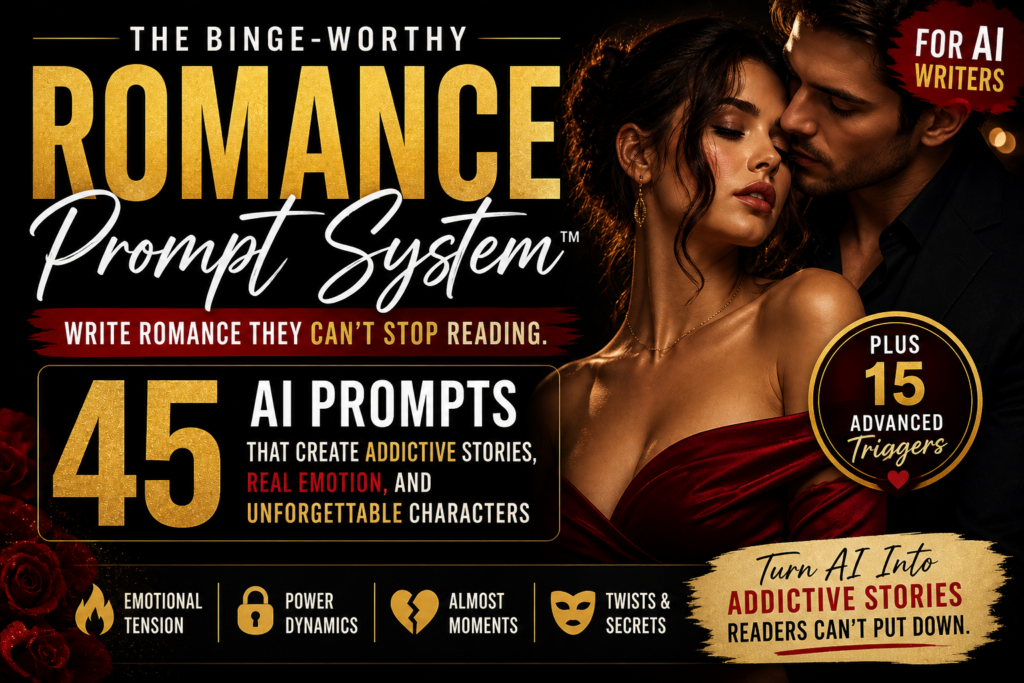
Then you don’t need more theory. You need better inputs. This is exactly why I’ve built the:
What You Get (Full Prompt Pack)
30 Core Prompts
emotional tension
power dynamics
character pull
15 Scene Upgrade Prompts
Spice Boosters
Plot Twist Injectors
Slow Burn Enhancers
Cinematic Detail Prompts
These aren’t basic prompts.
They’re designed to:
force emotional tension
create addictive pacing
upgrade weak scenes instantly
Click Here to get The AI Romance Prompt System.
The free strategies will get you started.
But the difference between a story being decent and I can’t put this book down all boils down to how your scenes are built.
That’s what most people miss, and that’s what these prompts fix.