Most five-book romance series die at book three.
Not because the writing got worse, but because the planning was off from the start. The author runs out of trope variety. The supporting cast starts to blur. The overarching thread quietly stops mattering. By book four, reviews are fine, sales aren’t, and nobody’s sure what went wrong.
The real engine of a series that compounds isn’t prose. It’s emotional environment. The town. The group chat energy. The brother everybody knows is getting his own book. The tiny unresolved tensions planted three books earlier. Romance readers aren’t buying stories anymore. They’re buying re-entry into a world they’ve grown attached to — and that attachment has to be engineered before book one exists.
I had to learn this the hard way. I was treating the outline as the easy part. The “fun” part. The part you knock out in a weekend before the real work starts. That was the mistake.
The outline IS the real work. Everything else is just typing.
In this post, I’m walking through exactly how I outline a five-book romance series with AI. The system I run, the prompts that catch what AI defaults to hiding, and the failure modes most authors don’t see until book four.
Quick Fix: One Line That Changes Every AI Outline Prompt
Before we get into the full system, do this.
Take any AI prompt you’re using to outline your series and add this exact line at the end:
“Be blunt. Don’t be encouraging. Tell me what’s most likely to fail.”That’s it.
AI defaults to cheerleading. It will tell you your premise is incredible, your characters are layered, and your pacing is “tight and immersive.” Useless. You don’t need a hype man. You need someone to find the cracks BEFORE you write 90,000 words on top of them.
That one line flips the output. Try it on something you’re working on right now. You’ll see.
The Read-Through Stack (My Exact System)
I don’t ask AI to “outline a series.” That gets you a Pinterest board with chapter numbers.
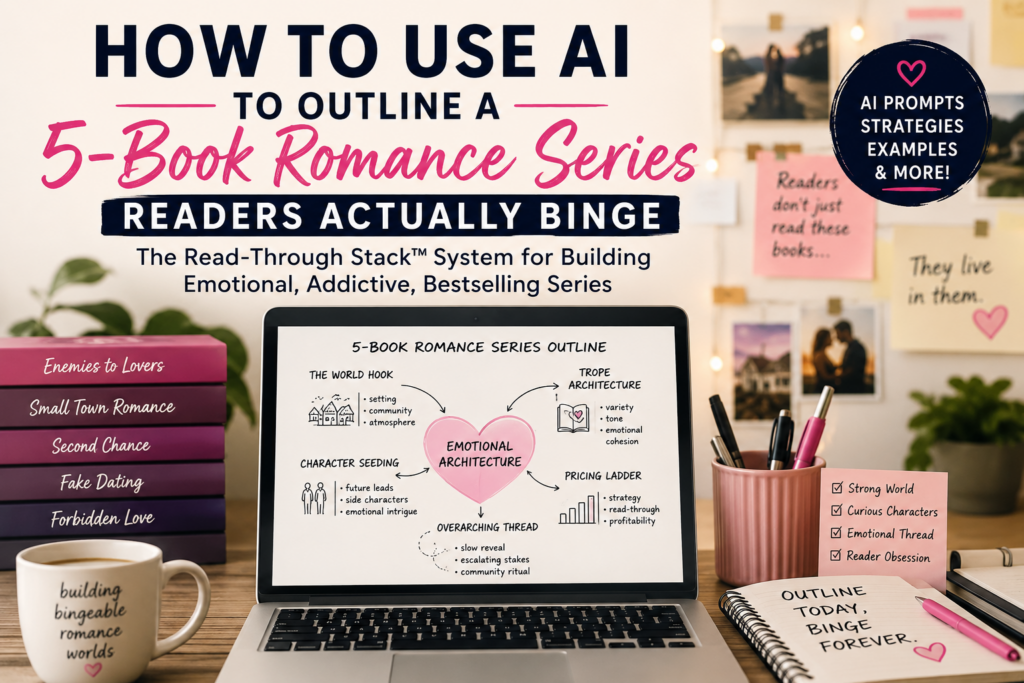
I run it through a stack. Five layers. In this order:
- The world hook — why does this series exist
- Character seeding — who are the five leads, and how do they appear in book one
- The overarching thread — what pulls readers from book to book that isn’t the romance
- Trope architecture — what trope goes where, and why
- The pricing ladder — what each book costs, and what book one costs forever
Order matters. Most authors plan in reverse. They start with tropes because tropes are fun and end up reverse-engineering a world to fit the tropes. The series feels like five books in a shared zip code. Readers can feel the difference.
Throughout this post, I’ll work the stack through one example: The Caldwells of Harbor’s End. A five-sibling small-town romance series, one book per sibling. You’ll see what each layer looks like worked through for a real (fictional) series, not just abstractly described.
Layer 1: The World Hook (Where Most Series Already Lost)
The world hook isn’t your setting.
“Small coastal town” is a setting. “A small coastal town where the founding families have been quietly feuding for a hundred years and the next generation is finally tired of it” is a hook.
The first one gives you one book. The second gives you five.
There’s a sub-question underneath the hook that most authors skip: what emotional experience does this world deliver? Nostalgia? Found-family comfort? Aspirational fantasy? Danger and obsession? The hook has to support that experience for five books, not one. A hook that delivers cozy comfort can’t suddenly pivot to dark obsession in book three without breaking the contract you made with book-one readers.
Before I do anything else, I run my hook through this prompt:
“I’m planning a five-book interconnected standalone romance series. My world hook is: [your one sentence]. The emotional experience the world delivers is: [comfort / aspiration / danger / etc.]. Give me three specific failure modes: (1) why this hook might run out of story by book three, (2) why readers might lose interest in the world after book one, (3) what’s missing that would make book five feel earned. Be blunt. Don’t be encouraging.”
If AI can’t find three failure modes, my hook is too thin. I rework it before I do anything else.
Worked example. Caldwells of Harbor’s End. Hook: Five siblings inherit their late mother’s failing inn in a Maine harbor town and have one year to save it before the bank takes it.
Emotional experience: found-family comfort with a financial-stakes engine underneath. Failure mode AI flagged: by book three, the inn-saving plot is resolved or the threat has lost urgency, and there’s no second engine.
Fix: the inn isn’t just failing, there’s also a buyer circling, a family secret about why the mother left in the first place, and a town that’s slowly choosing sides. Now there’s runway for five books.
This is the single most important step. Skip it and you’ll feel it in book three. I Promise.
Layer 2: Character Seeding (The Trap Most Authors Walk Into)
Now the five leads.
Not their love interests. The five protagonists who anchor each book.
Here’s the trap: in book one, the future leads have to appear. With enough texture that readers leave book one already half in love with two of them. But not so much that they steal focus from the book-one couple.
Get this wrong and you’ll see it in your reviews. The killer review for book one is:
“I didn’t really care about the main couple, I just wanted more of [side character].”
That review tanks read-through. Readers feel cheated. They don’t trust you with book two.
The prompt I run:
Here are my five future leads: [name, one-line description, role in their own book]. They all appear in book one. For each one, give me: (1) the minimum number of scenes they need, (2) one scene type that establishes their character without revealing their love story, (3) one line of dialogue that hints at the wound their book will heal. Then flag which of the five is most likely to overshadow the book-one couple, and how to dial them back.
That last sentence is the one that earns the prompt. AI will tell you which character is going to steal book one. It just won’t volunteer it.
The wound rule. Every romance lead has one. The wound is what the love interest’s presence eventually heals. If you can’t name the wound for each of your five leads in a single sentence, you don’t have five books yet. You have a vibe.
Worked example. The five Caldwells: Maeve (oldest, took over the inn at 22, never lived for herself — book one), Theo (left for the city, came home in disgrace — book two), Lila (the people-pleaser nobody asks what she wants — book three), Cal (the angry one, blames himself for their mother — book four), and Ronan (the youngest, hides behind charm — book five).
The wound for each is one sentence. The character most likely to overshadow Maeve in book one? Theo. He’s louder, more visibly damaged, and his return is more dramatic than Maeve’s quiet competence. Dial-back move: keep Theo off-page for the first 40% of book one. Let readers hear about him before they meet him.
Layer 3: The Overarching Thread (Where “Series” Becomes Real)
This is the layer most outlining advice waves its hand at. “Have an overarching thread,” they say. “A family secret. A community event. A business.” Okay. Which one? And why? Three patterns work. Most others don’t.
The slow reveal. A secret or mystery that surfaces a little more in each book. Huge read-through engine. Requires you to know the answer before book one.
The escalating stakes. A shared situation such as a business failing, a town dying, a family dividing — that gets worse across books one through four and resolves in book five. Gives book five real weight. Tonally heavy.
The community ritual. Something that happens every book. A wedding, a holiday, a town festival. Easy to execute. Lower stakes on its own.
The series that work usually combine a community ritual WITH a slow reveal or escalating stakes. The ritual is the texture. The reveal is the engine.
I stress-test the thread against my book-one draft:
My overarching thread is [thread]. Here’s my book one premise: [paragraph]. Tell me: (1) where in book one the thread is currently invisible and needs to be planted, (2) which of my five leads is best positioned to advance the thread in their book, (3) one risk that this thread will feel forced or gimmicky by book four. Tell me how to mitigate that risk in the outline.
If the thread can’t survive that prompt, it can’t survive five books.
Worked example. Caldwells: the inn’s financial threat is escalating stakes. The town’s annual harbor festival (every Labor Day weekend, every book takes place across one season) is the community ritual. The slow reveal is what their mother was actually running from — surfaces a layer per book, fully resolved in book five. Three engines, layered. That’s why this series can carry five books instead of two.
Layer 4: Trope Architecture (Where Most Advice Falls Apart)
Standard advice says vary your tropes. Book one enemies-to-lovers, book two second chance, book three fake dating, etc. Five books, five tropes, neat row.
Real series don’t work like that. Whatever you pick for book one becomes a promise to the reader about what kind of series this is. If book one is a tense, slow-burn enemies-to-lovers and book two is a goofy fake dating with a forced-proximity sitcom plot? You broke the contract. The readers who came for book one don’t come back for book two.
Trope variety matters. Tonal coherence matters more.
What works: variety in the mechanic, sameness in the feel.
Enemies-to-lovers and forbidden romance feel similar. High-stakes. Charged. Tense. Friends-to-lovers and second-chance feel similar. Warm. Layered. Interior.
Mix within a register. Don’t mix across.
The prompt:
My book one is a [trope] in [tone — slow-burn, banter-driven, angsty, etc.]. Suggest four tropes for books two through five that vary the mechanic but keep the tonal register. For each one, explain why it fits, and flag any that risk breaking the tonal contract with my book-one readers.
There’s a follow-up prompt I run right after, because trope variety alone isn’t the goal, emotional differentiation is:
For my five planned couples, identify which one feels emotionally safest, which feels emotionally explosive, which carries the deepest vulnerability, and which delivers the most healing. Flag any two couples that feel emotionally too similar — that’s the pair most likely to cause binge fatigue.
Two couples that feel emotionally identical is the quiet killer of a five-book series. Tropes are the marketing. Emotional contrast is what keeps readers from feeling like they’re reading the same book five times.
One more thing nobody talks about: book four is the problem child of every five-book series.
Book one introduces. Book two expands. Book three tests (this is where the slump lives). Book five resolves. Book four has to EARN the resolution. Most authors plan it the least and write it the fastest. Plan book four with the most care, not the least.
Worked example. Caldwells: book one is a slow-burn second-chance (Maeve and the contractor she dated at nineteen). Tonal register: warm, layered, interior. Books two through five stay in that register but vary the mechanic — Theo’s enemies-to-lovers (book two), Lila’s friends-to-lovers (book three), Cal’s grumpy/sunshine forbidden romance with the bank’s lawyer (book four — note the structural complexity earning the resolution), Ronan’s fake dating that becomes real (book five). All warm. All interior. None tonally dissonant.
Layer 5: The Pricing Ladder
By the time you get here, the strategic work is done. Pricing is execution.
The basics: book one cheap or free. Books two through five at standard pricing. Occasional sales on book one to refresh the funnel.
Underneath that, there’s a decision tree.
Free book one works if: you’re in KU (so the “free” is page reads, not lost royalties), your read-through is strong, and your back matter actually converts. If any of those three is missing, free book one is a leak.
99 cents works if: you’re wide, you have an ads budget, and you want a price point paid promo sites accept (most require sub-$3).
Standard pricing on book one ($3.99–4.99) works once the series is established. Don’t start there.
I run this prompt to model it:
“I’m pricing a five-book romance series. Book one is [price]. Books 2–5 are [price]. Calculate revenue per acquired book-one reader at read-through rates of 80% from book 1→2, 75% from 2→3, 70% from 3→4, 80% from 4→5. Then run the same calculation at 60/55/50/65 to show me the downside. Tell me where the pricing decision matters most.
The answer will surprise you. The single highest-leverage point in series pricing isn’t book one. It’s whether book three converts to book four. Which brings us right back to where we started. Plan book three to test the world, not expand it. That’s how you protect the entire revenue model of the series.
What Nobody Tells You About AI Series Planning
A few things, fast.
AI lies to you about market trends. Ask which trope is “trending” and you’ll get a confident answer that’s six months stale. Romance moves faster than any model’s training data. Use AI for structure. Use TikTok, KU also-boughts, and your reader email for trends.
Don’t outline all five books in equal detail at the start. Outline book one to scene level. Books two through five to premise-and-conflict level. Book five to vibe only. You’ll learn things writing book one that change everything downstream. The outline is rolling, not a contract.
The “next book hook” is overweighted. Series-planning advice obsesses over cliffhangers and setup hooks at the end of book one. They matter less than the quality of book one’s HEA. Readers who feel emotionally satisfied buy book two. Readers who feel jerked around don’t, no matter how good your hook is.
Three-star reviews are an outline tool. After book one launches, your three-star reviewers will tell you what to adjust in books two through five. Not your one-stars. Not your five-stars. The three-stars liked the book enough to finish it but had a specific complaint they took the time to write down. That complaint is your edit list.
Most authors chase the one-star reviews. Mistake.
Don’t build a series around AI. Build a series around a hook you’d write whether or not AI existed. THEN use AI to pressure-test it. If AI is generating the premise, readers will eventually tell. They always do.
Want the Prompts That Run This Whole Stack For You?
The five prompts above are the core. They’ll get you most of the way there.
But the difference between “I have an outline” and “I have a series that compounds” is the next 25 prompts. The ones that catch failure modes at the scene level. The ones that pressure-test character wounds against trope choices. The ones that model your read-through math against three different pricing scenarios.
That’s what I built into the Read-Through Stack Planner — the full Notion template, all 30 prompts, plus the complete worked outline for The Caldwells of Harbor’s End so you can see what every layer looks like fully built out.
[Get the Read-Through Stack Planner →]
The free version of the system gets you started.The full planner is what you use when you’re done playing.
FAQ: AI for Romance Series Outlining
AI can pressure-test, structure, and accelerate a series outline. You bring the hook, the wounds, and the vision. AI catches the structural failures you can’t see from inside your own work.
ChatGPT and Claude both work for the prompts in this post. Sudowrite and NovelCrafter add genre-specific scaffolding once you’re past the outline and into chapters. Don’t pay for a romance-specific tool to do outline-level thinking. The general models are better at it.
Match your subgenre. Contemporary 70K–90K. Romantasy 110K–150K. Small-town 80K–100K. Consistency across the series matters more than the absolute number — readers form expectations after book one.
Free if you’re in KU and have strong read-through. 99 cents if you’re wide. The decision is downstream of your distribution model, not your branding.
Plan book three to TEST the world, not expand it. Books one and two introduce. Book three should put real pressure on something readers have come to care about. Most slumping book threes are functionally another book two.
A five-layer system for outlining a romance series in the order that protects read-through: world hook, character seeding, overarching thread, trope architecture, and pricing ladder. Each layer constrains the layer below it.
Publishing Tools
Magica.Comcontains ChatGPT, Claude, Perplexity, and more! Perfect for creating outlines, chapter drafts, series bibles, and more. Also, it contains tools to create cover images
Best for writing the actual romance stories.
Note: affiliate links are included