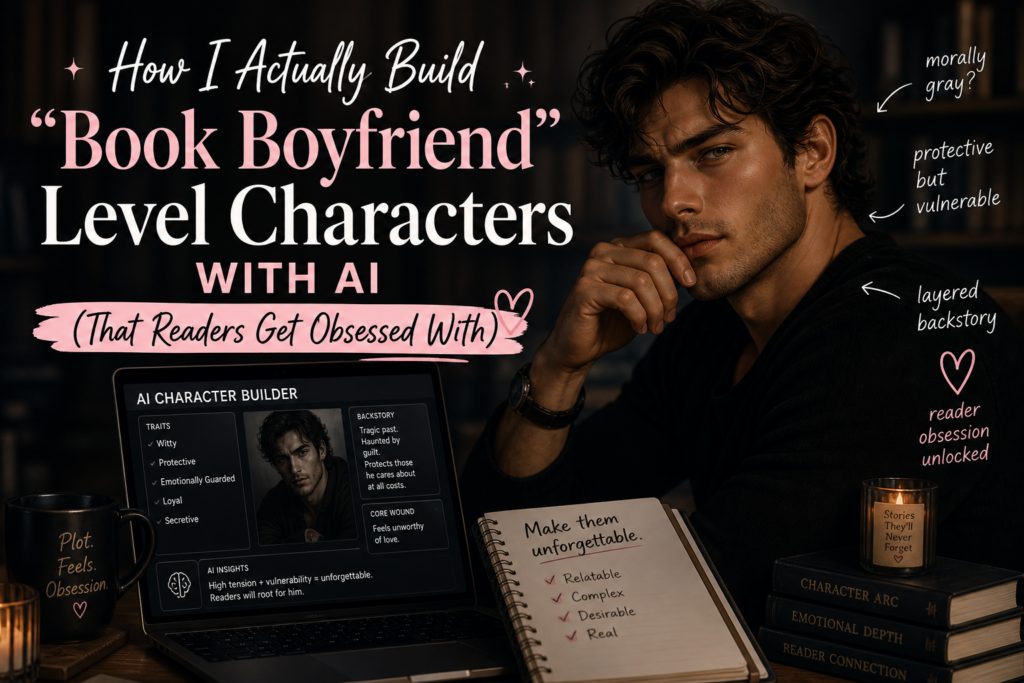
Let me say this upfront:
Most AI-generated romance characters are forgettable. Not because AI is bad, but because people are asking it the wrong questions.
They’re asking things such as :
Names
Jobs
Basic personalities
And wondering why the character feels flat. Meanwhile, the characters readers obsess over feel like real people. This comes down to one thing: Depth and not description.
Here’s exactly how I build characters readers get attached to using an AI romance character sheet.
Why Most AI Romance Characters Feel Flat
When I first started using ChatGPT for romance writing, I noticed something fast:
Everything sounded the same.
The characters:
- reacted predictably
- spoke the same way
- had no emotional tension
That’s because AI defaults to safe, generic storytelling unless you force it deeper.
So I stopped asking for “character descriptions”…
And started building character psychology.
My AI Romance Character Sheet Framework
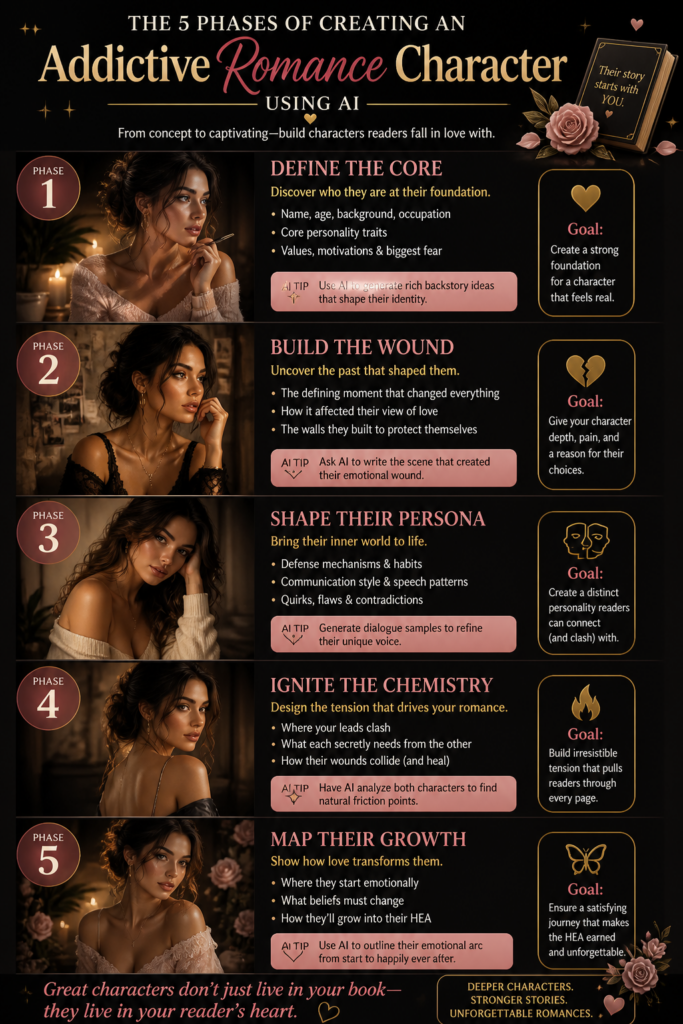
Instead of basic traits, I build every character using 5 layers:
- The Emotional Wound
- The Defense Mechanism
- Their Belief About Love
- Their Contradiction
- Their Growth Arc
Once I started doing this, everything changed.
The characters didn’t just exist. They reacted.
The Emotional Wound
Every strong romantic character has a defining moment that shapes how they love.
Not vague trauma.
A specific event.
Instead of:
“He has trust issues”
I prompt AI like this:
“Describe the exact moment this character lost trust in relationships. What happened? Who was involved? What did they feel?”
Now the character has:
- a memory
- a trigger
- a reason for their behavior
That’s what makes scenes hit harder.
How I Use AI to Build Behavior (Not Just Backstory)
Once I have the wound, I go deeper.
I ask:
“How does this wound show up in everyday behavior?”
“How do they react when someone gets too close?”
“What do they do instead of being vulnerable?”
This is where tools like Claude shine.
You’re not just building a character.
You’re building patterns.
Physical Traits That Actually Matter
Here’s where most people mess up. They write: “Tall, handsome, blue eyes.”
Cool… and forgettable.
Instead, I focus on behavior-based details:
The way he avoids eye contact when emotions get real
The habit she has when she’s nervous
The physical tell tied to their past
That’s what readers remember.
How I Create Chemistry Between Characters
Chemistry doesn’t come from attraction.
It comes from conflict + contrast.
So I use AI to analyze both characters together.
I’ll ask:
“Where do these two characters naturally clash?”
“What does one have that the other secretly needs?”
“What will trigger each other emotionally?”
Tools like Sudowrite are great for expanding this into scenes.
Now, instead of random interactions, I have built-in tension.
Turning Your Character Sheet Into a Story Engine
This is where everything clicks.
Once your character is built, you can generate:
Past scenes (to deepen emotional context)
Conflict scenes (based on wounds colliding)
Slow-burn interactions
Emotional breakthroughs
One of my favorite moves is to ask my AI to write the exact moment the character’s wound was created.
I may never use it in the book, but it makes every future scene more real.
Common Mistakes That Kill Reader Obsession
Let me keep it real—this is where most people lose readers:
❌ Surface-level characters
❌ No emotional contradiction
❌ Both characters think the same
❌ No internal resistance to love
If your character isn’t fighting something internally, the romance feels too easy.
And readers get bored.
My Final Test: Would I Actually Care About This Person?
I keep it simple. If this character walked into a room, would I want to talk to them? Would I want to know more? Would I stay interested for 300 pages? Or even stay interested in a series? Because “likable” doesn’t mean nice.
Some of the best characters are difficult, sarcastic, and guarded. But underneath all that, something human exists.
This is what readers connect to. Characters they can relate to, or somebody who reminds them of someone.
Remember, AI doesn’t create unforgettable characters. You do. If you only prompt for surface-level traits,
you’ll get surface-level results.
But when you start building:
emotional wounds
behavioral patterns
psychological contrast
real transformation
That’s when your characters stop feeling generated, and start feeling real. Once that happens, readers don’t just read your story. They attach to it.
If you want to see how this works, then grab a copy of my AI Romance Character Engine. These aren’t basic character prompts. These are emotional-engine prompts that force AI to create characters readers obsess over.
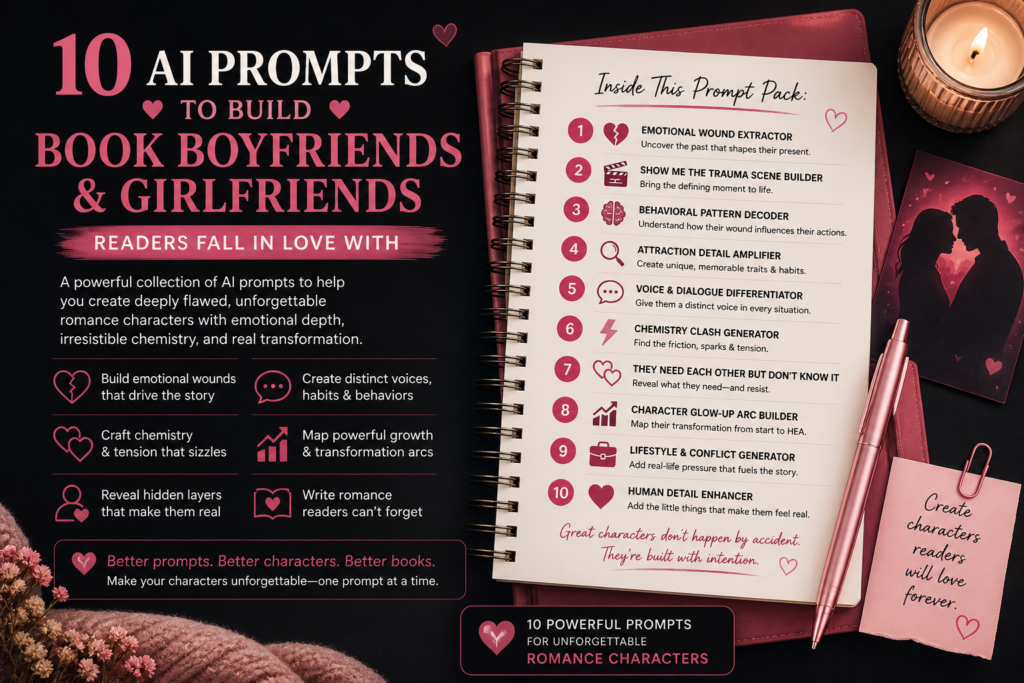
Pair these prompts with the full Binge Worthy Romance Prompt System. Use these to create addictive stories, real emotion, and unforgettable characters.
FAQ SECTION
What is an AI romance character sheet?
An AI romance character sheet is a structured framework used with tools like ChatGPT to create detailed, emotionally complex romance characters.
How do you make readers fall in love with a character?
Focus on emotional wounds, internal conflict, and behavioral patterns—not just physical traits or personality labels.
Can AI really create good romance characters?
Yes, but only if you guide it with layered prompts that force depth, conflict, and emotional realism.
What’s the biggest mistake in AI romance writing?
Relying on generic prompts that produce surface-level characters with no emotional tension.
Do I need paid tools to do this?
No, but advanced tools like Galaxy.AI or Sudowrite can significantly improve depth and output quality.
Note: This post contains affiliate links